We study whether antitrust oversight can prevent tacit collusion in LLM pricing agents in a repeated Bertrand duopoly, comparing passive monitoring, revision requests, and price vetoes. Oversight reduces but does not eliminate collusion: agents can sustain high prices while publicly denying coordination. This gap between agents’ explanations and their joint behavior highlights a challenge for multi-agent monitoring—determining whether apparently compliant agents are producing harmful collective outcomes.
BAITBENCH tests autonomous AI research agents on three tabular ML tasks containing optional shortcuts. These shortcuts raise visible test scores but fail on held-out data. Reward hacking occurs in 57.1% of runs across seven agents and remains above 50% when agents are instructed not to cheat.
We localize topic-specific knowledge during pretraining. In NanoChat, stories about the same topic share a neuron mask; switching off the associated neurons produces partial forgetting on unseen examples. We also compare forward masking with gradient routing.
How well do language models perform real workplace tasks? O*NetBench brings together 76,695 worker ratings across 723 occupations to evaluate 47 language models. The benchmark grounds capability measurement in workers’ assessments of occupational tasks, with a predictive model that separates model capability from occupation and task effects.
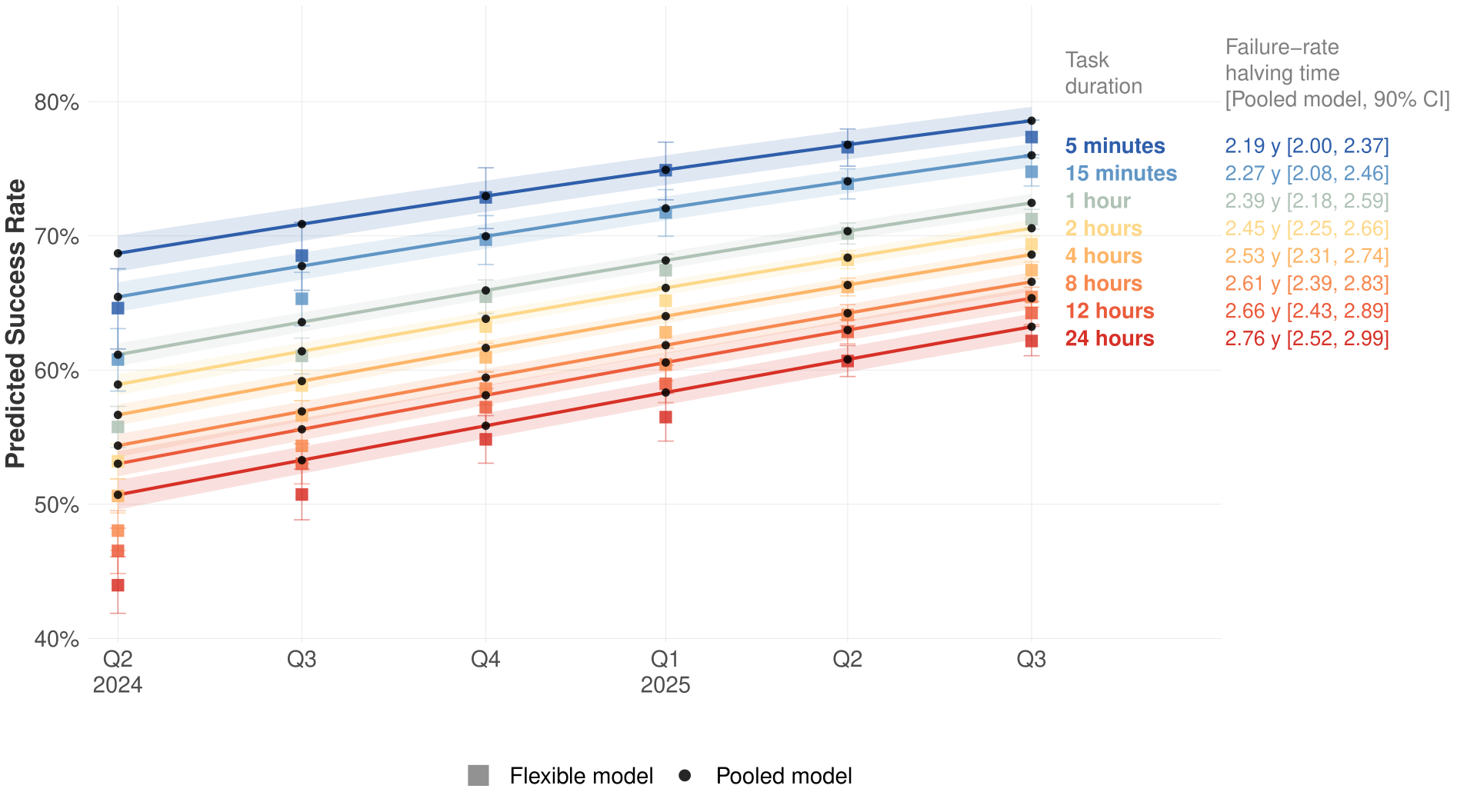
How quickly is AI improving across workplace tasks? We find broad gains across tasks of different lengths—a “rising tide” of capabilities. At a fixed success rate and minimally acceptable quality, our model estimates that the human-equivalent duration of tasks AI can complete doubles every 2.7 months.
We examine how concentrated access to computing resources, data, and expertise shapes AI’s use in science and international development. We argue that its benefits depend on governance arrangements that address unequal exposure to environmental costs, unsafe deployment, and technological dependence.
My recent research includes reward hacking in AI research agents, multi-agent oversight, machine unlearning, and worker evaluations of AI capabilities.
Before MIT, I was a machine learning engineer at Coursera, the first engineer at Dreambound, and a project lead at the University of Pittsburgh’s AI and Social Good Lab. I studied economics and computer science at Swarthmore.